

How to Remove Iron from Silica Sand Efficiently: A Complete Guide
How to Remove Iron from Silica Sand Efficiently: A Complete Guide
Introduction
Silica sand is one of the most important industrial minerals, widely used in glass manufacturing, photovoltaic panels, foundry casting, ceramics, electronics, and chemical industries. As the demand for high-purity silica sand continues to grow, especially in solar glass and semiconductor applications, the removal of iron impurities has become a critical step in silica sand processing.
Iron contamination can significantly reduce the quality and value of silica sand products. Therefore, selecting an efficient iron removal process is essential for producers seeking higher product grades and stronger market competitiveness.
This article explores the main sources of iron impurities, common iron removal methods, and the role of advanced magnetic separation technology in modern silica sand processing plants.
Why Iron Removal Matters
Iron-bearing minerals are commonly associated with quartz deposits. These impurities can appear in various forms, including:
- Hematite (Fe₂O₃)
- Magnetite (Fe₃O₄)
- Limonite (FeO(OH)·nH₂O)
- Biotite
- Garnet
- Clay minerals containing iron
Even a small amount of iron can negatively affect the color, transparency, and performance of silica sand products.
For example:
| Application | Typical Fe₂O₃ Requirement |
|---|---|
| Ordinary Glass | <0.10% |
| Ultra-Clear Glass | <0.03% |
| Solar Glass | <0.015% |
| High-Purity Quartz | <0.01% |
As product requirements become more stringent, efficient iron removal technology becomes increasingly important.
Main Iron Removal Methods
1. Washing and Desliming
Washing removes surface coatings, clay particles, and loosely attached iron contaminants.
Advantages:
- Simple operation
- Low investment cost
- Effective for surface contamination
Limitations:
- Cannot remove iron locked inside mineral particles
- Limited purification capability
2. Gravity Separation
Gravity separation utilizes density differences between quartz and iron-bearing minerals.
Common equipment includes:
- Spiral chutes
- Shaking tables
- Hydrocyclones
Advantages:
- Low operating cost
- Suitable for coarse particles
Limitations:
- Limited effectiveness for fine particles
- Not suitable for achieving high-purity silica grades
3. Flotation
Flotation separates iron-containing minerals through reagent chemistry.
Advantages:
- High purification potential
- Suitable for fine particles
Limitations:
- Complex process control
- High reagent consumption
- Environmental considerations
4. Acid Leaching
Acid leaching dissolves iron impurities chemically.
Common acids include:
- Hydrochloric acid
- Sulfuric acid
- Oxalic acid
Advantages:
- Excellent purification performance
- Suitable for ultra-high-purity products
Limitations:
- High operating cost
- Wastewater treatment requirements
- Corrosion issues
5. Magnetic Separation
Magnetic separation is currently one of the most widely used and economical methods for iron removal in silica sand processing.
It effectively removes:
- Magnetite
- Hematite
- Limonite
- Garnet
- Weakly magnetic iron-bearing minerals
Advantages:
- High efficiency
- Continuous operation
- Low operating cost
- Environmentally friendly
- Suitable for large-scale industrial production
High Gradient Magnetic Separation Technology
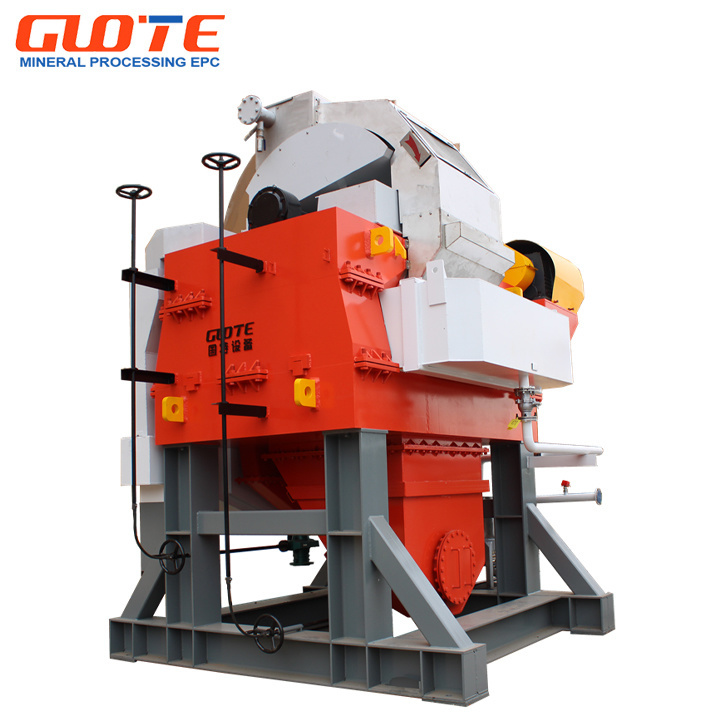
Among all magnetic separation technologies, High Gradient Magnetic Separation (HGMS) offers the best performance for silica sand purification.
HGMS systems generate strong magnetic fields capable of capturing weakly magnetic impurities that conventional magnetic separators cannot effectively remove.
Working Principle
The silica slurry passes through a magnetic field generated by an electromagnetic coil. A specially designed matrix amplifies the magnetic force, attracting weakly magnetic particles while allowing purified quartz particles to pass through.
The result is significantly reduced iron content and improved product quality.
Key Benefits
- High magnetic intensity
- Excellent iron removal efficiency
- Suitable for fine particle sizes
- Stable operation
- High throughput capacity
For many silica sand producers, HGMS has become a standard process in achieving high-purity quartz products.
Typical Silica Sand Iron Removal Process
A modern silica sand purification plant may include the following stages:
- Crushing
- Screening
- Washing and Desliming
- Classification
- High Gradient Magnetic Separation
- Flotation (if required)
- Dewatering
- Drying
- Finished Product Storage
This combination allows producers to achieve high recovery rates while meeting strict purity requirements.
Case Example
A silica sand processing project required reducing Fe₂O₃ content from 0.18% to below 0.03%.
Process Configuration:
- Washing and Desliming
- Classification
- High Gradient Magnetic Separation
Results:
| Parameter | Before Treatment | After Treatment |
|---|---|---|
| Fe₂O₃ Content | 0.18% | 0.025% |
| SiO₂ Content | 98.1% | 99.3% |
| Product Whiteness | Improved Significantly | |
| Recovery Rate | >90% |
The project successfully met the requirements for high-quality glass manufacturing.
Choosing the Right Magnetic Separator
When selecting a magnetic separator for silica sand processing, several factors should be considered:
Ore Characteristics
- Iron mineral type
- Iron content
- Particle size distribution
Production Capacity
- Plant throughput
- Continuous operation requirements
Final Product Requirements
- Glass-grade silica sand
- Solar glass silica sand
- High-purity quartz sand
Operating Cost
- Energy consumption
- Maintenance requirements
- Spare parts availability
A detailed mineralogical analysis is recommended before selecting equipment.
Future Trends in Silica Sand Purification
As industries demand increasingly pure silica products, future processing plants will focus on:
- Intelligent process control
- Automated operation systems
- Energy-efficient magnetic separation
- Digital monitoring platforms
- Sustainable mineral processing technologies
Advanced magnetic separation equipment will continue to play a central role in meeting these evolving market demands.
Conclusion
Iron removal is a crucial step in silica sand beneficiation. While washing, gravity separation, flotation, and acid leaching all have their applications, magnetic separation remains one of the most efficient and cost-effective solutions for industrial-scale production.
High Gradient Magnetic Separation technology provides excellent performance in removing weakly magnetic impurities, helping producers achieve higher silica purity, improved product quality, and greater market value.
For companies seeking to produce high-quality silica sand for glass, solar, and advanced industrial applications, investing in an optimized magnetic separation process is a key factor for long-term success.
Iron Removal from Silica Sand,Silica Sand Processing Plant,High Gradient Magnetic Separator,Quartz Sand Purification,Magnetic Separation Technology,High Purity Quartz Sand,Mineral Processing Equipment
Previous Page
Previous Page
Related Products

Related News